Audience Research & Content Strategy · Case Study · 04

Global Tinker

Helping the founders of a children's media company turn an open-ended content idea into a viable audience, a reusable framework, and a prototype they could evaluate before investing in production.

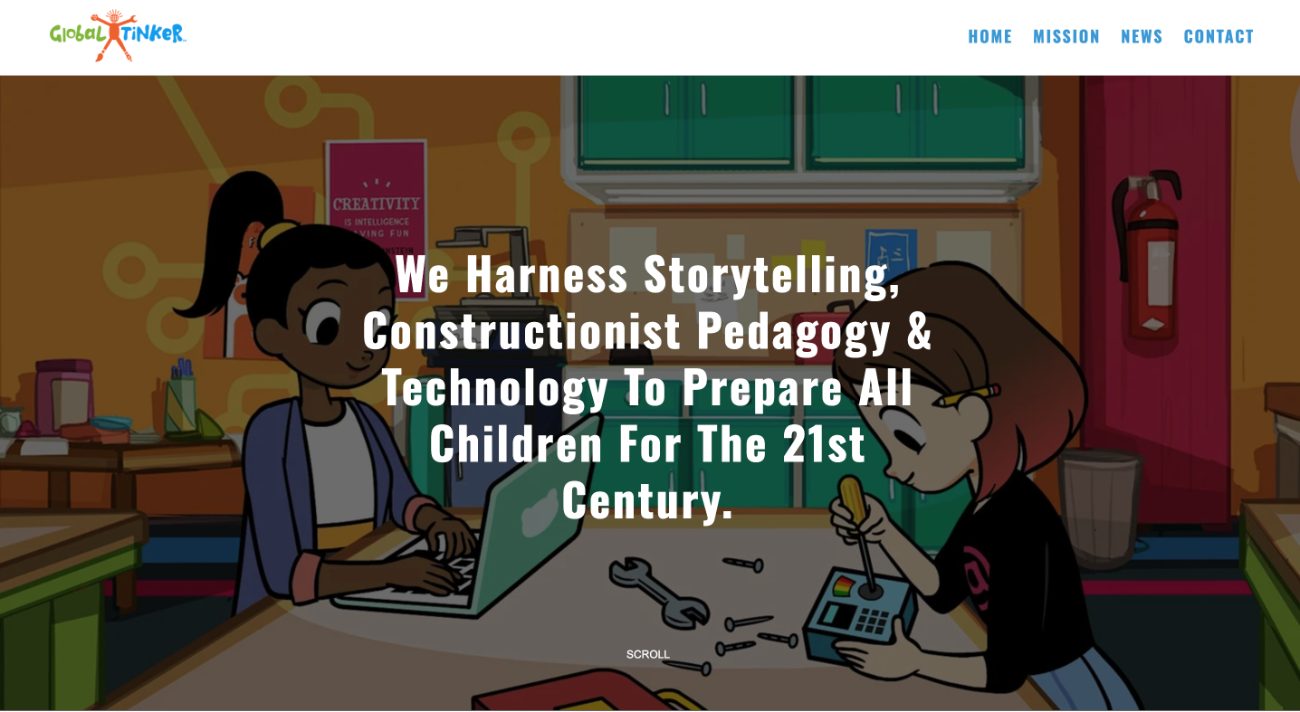
Global Tinker home page

My Role

Audience Research & Content Strategy ConsultantAdvising the founder & co-founder

Organization

Global Tinker ↗Award-winning children's media & edtech

Timeline

Jan 2025 – PresentOngoing paid consulting, project-based

Research basis

Secondary & content researchNo primary user research in this engagement

Overview

A strong mission, and an idea still taking shape.

Global Tinker is a multi-award-winning children's media and educational-technology company preparing kids for the 21st century through creativity, collaboration, critical thinking, scientific inquiry, and social-emotional learning, with products including The Paper Girls Show, Scientist Maker, and its mindfulness and after-school programs.

I first connected with the founder and co-founder in October 2024, and the paid consulting work began in January 2025. They had a compelling mission and more content ideas than any small team could pursue. What they needed first wasn't production, it was clarity: which audience, which educational positioning, and which scope was actually worth building.

The engagement continues on an intermittent, project-based basis, periodic strategic conversations and one-off projects.
The business question

STEM interest is high, access feels low.

Despite growing interest in STEM, many families don't know where to start, or feel excluded from science learning. Most parenting newsletters skew too academic or too commercial. Global Tinker wanted to reach families with something that made science feel local, joyful, and doable, but the concept, audience, and scope were all still open.

My job was to narrow that ambiguity into something concrete enough to judge.

My role & the collaboration

Advising the founders, then building the concept.

The founder and co-founder commissioned the work and shaped it through ongoing conversations, feedback, and strategic ideation. I independently translated those discussions and my desk research into the concept, the content framework, the sample copy, the activities, the interview template, and the layout prototype.

What I advised on & created

Audience strategy Secondary & content research Educational positioning Scope & scalability advice Content architecture Recurring section framework Copy, activities & prompts Layout prototype Engagement & growth concepts

How I approached it

Secondary research, honestly labeled.

Secondary & content research

This engagement was pre-launch strategy, not user research. My audience work drew on desk and secondary research, competitive and content analysis, my developmental-psychology training, and years of professional experience with children, families, educators, and youth-serving programs.

I did not conduct interviews, surveys, or usability testing with parents, educators, or children for this concept. Given the stage, secondary research was the right instrument: the founders needed to decide whether to build before it made sense to spend budget testing what to build. Naming that boundary was part of the deliverable, the concept came with a note that primary validation should precede launch.

01

Educational grounding

Desk research across child development, learning sciences, constructionist and inquiry-based learning, STEM/STEAM engagement, and social-emotional development, to establish what content would actually be developmentally appropriate.

02

Competitive & content analysis

Studied five leading newsletters across parenting, education, and the wider consumer market, capturing what worked and what fell flat in each, then distilling transferable patterns.

03

Audience framing

Mapped the needs of the three audiences Global Tinker serves, and advised on which to lead with given the team's actual capacity.

04

Architecture & prototype

Turned the strategy into a six-section framework, wrote the content, and built a two-page layout prototype the founders could react to.

Competitive & content analysis

Learning from the best newsletters out there.

Five newsletters, each read for what it does well and where it loses a reader, then carried through to a decision about Global Tinker's own format.

What I looked atWhat it showedWhat I decided from it

Child Mind Institute

Clear headers, highlighted quotes, and credible research framing, but dense blocks and a clinical tone.

Interpretation

Credibility and readability were pulling against each other. Research framing earns trust; density loses the parent reading on a commute.

Decision

Keep the research grounding, deliver it in short, scannable units with a warm voice.

TheSkimm

Engaging storytelling, Q&A format, consistent voice, and strong personality, with a commercial edge.

Interpretation

Voice is what makes a newsletter feel like a person rather than a brand, but the sales pressure is what parents said they distrust elsewhere.

Decision

Adopt a defined voice, an excited teacher texting a parent, with no product push in the core content.

Morning Brew

Short and skimmable at roughly 230–300 words, bite-size sections, playful tone.

Interpretation

The length ceiling is real. Anything longer competes with everything else in a parent's morning.

Decision

Cap sections to that word range and make every section skimmable on its own.

Brain Food

Weekly themes, quotes, micro-insights, and a strong sense of ritual.

Interpretation

A recurring rhythm does the retention work that novelty can't sustain, especially for a small team.

Decision

Build a fixed recurring framework so each issue is a fill-in, not a fresh invention, the scalability point the founders needed.

Just in Time Parenting

Age-specific, research-based, well-targeted, but visually plain and low on delight.

Interpretation

Being right about development isn't enough. If it doesn't look joyful, it doesn't get opened.

Decision

Treat visual design and playfulness as educational features, not decoration.

The recommendation it produced

To stand out, Global Tinker's newsletter should follow a simple 3-part rhythm: a quick STEM insight for parents, a hands-on activity for kids, and a resource or call-to-action, short, recurring, and doable by a small team every week.

Audience framing

Three audiences, one shared goal.

Global Tinker serves three audiences with genuinely different needs. Mapping them, from secondary research and my applied experience, let me advise the founders on who to lead with rather than trying to serve all three equally in one product.

Parents

Supporting curiosity, encouraging creativity at home, building critical thinking, navigating tech use, and fostering resilience.

Educators

Integrating STEAM, supporting inquiry-based instruction, boosting engagement, and teaching scientific reasoning.

Children

Age-appropriate experiences, real engagement drivers, motivation & curiosity, and hands-on learning.

My advice: lead with parents as the subscriber, design the activities for children as the end user, and keep educators as a secondary distribution channel rather than a third content track, a scope call the small team could actually sustain.

Content architecture

“Little Scientist, Big City.”

The strategy became Scientist Maker, a “Summer of Science” concept positioning NYC families, educators, and their kids as everyday scientists. I built a six-section recurring framework so each issue could be produced against a template rather than invented from scratch.

Voice: an excited teacher texting a parent. Mood: curious, playful, community-focused.

01

Big WonderThe opening hook, a question worth being curious about.

02

Your Backyard ScienceA hands-on activity using what's already around you.

03

Local ScientistsA Q&A template spotlighting real scientists in the community.

04

In the KnowEvents, resources, and what's happening nearby.

05

Fast Facts & “Why?” ChallengeMicro-content plus a prompt kids can answer.

06

Bonus Scavenger HuntA shareable activity that extends past the issue.

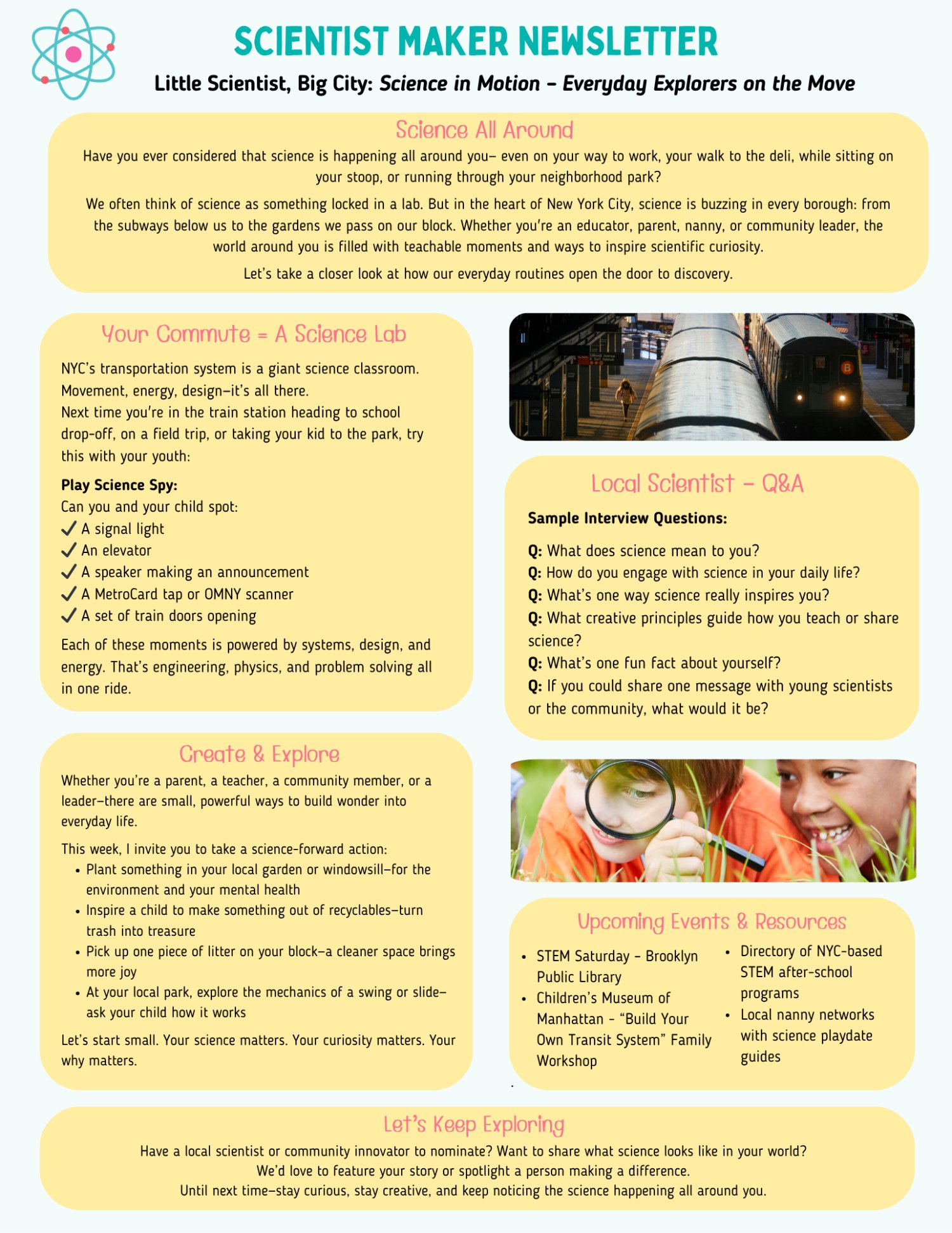
Scientist Maker newsletter concept prototype
Concept prototype, created by Precious Elam; not published the two-page Scientist Maker layout: content, copy, activities, and structure, built so the founders could evaluate the concept before investing in launch. Click to view full size.

A recurring section I created

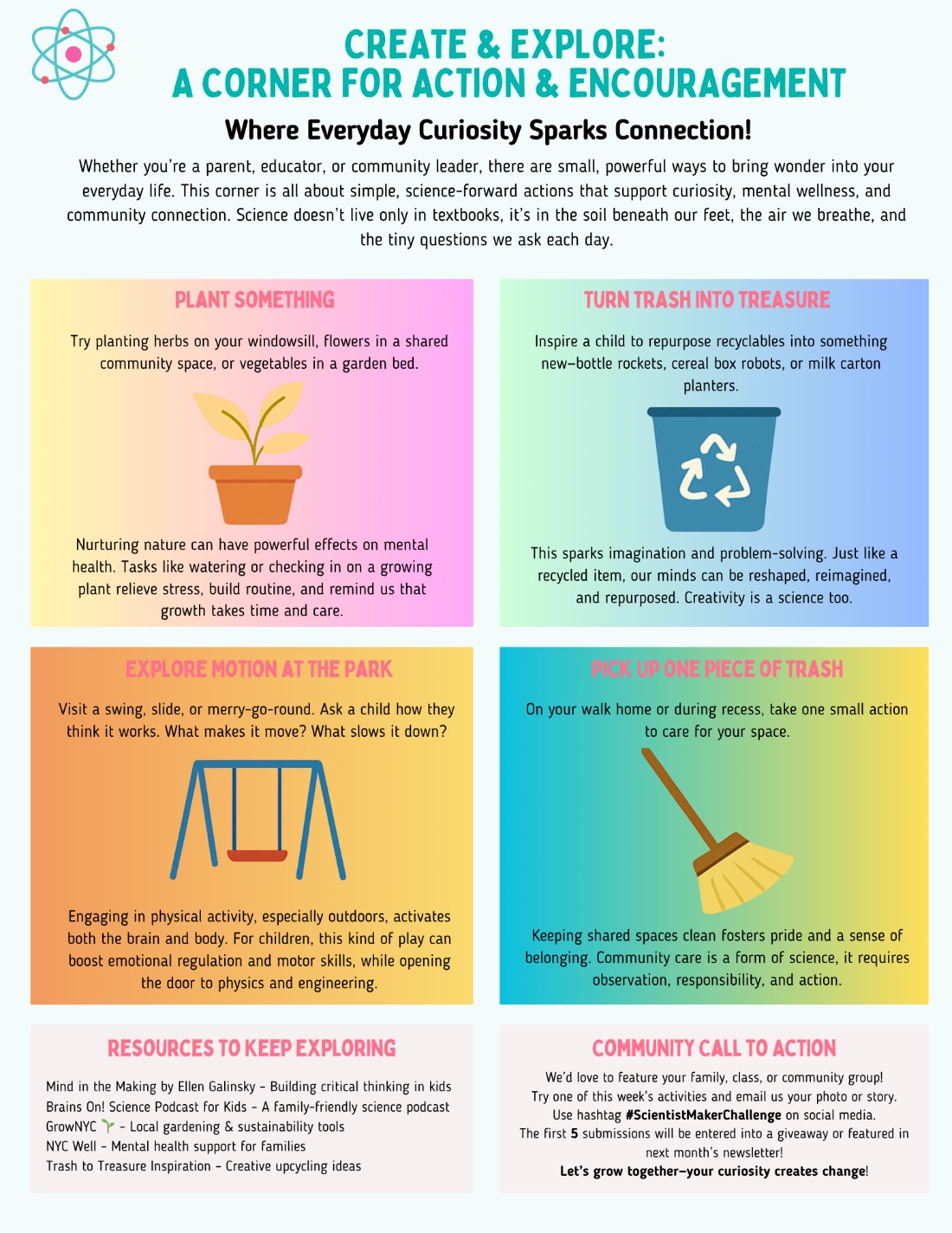
Create & Explore: a corner for action.

I created Create & Explore, a recurring page of small, science-forward actions any family can take, each tied to a developmental or wellbeing benefit: plant something (mindfulness and patience), turn trash into treasure (design thinking), explore motion at the park (physics and emotional regulation), pick up one piece of litter (civic pride).

It connects science to everyday life, creativity, community care, and mental health, and closes with a community challenge to drive sharing. The design intent was to lower the barrier: science as something already happening on the train, at the park, in a windowsill garden.

Create and Explore expanded section
Create & Explore, expanded version concept, copy, and layout by me: four science-forward family actions, each tied to a developmental benefit, plus a community challenge. Click to view full size.
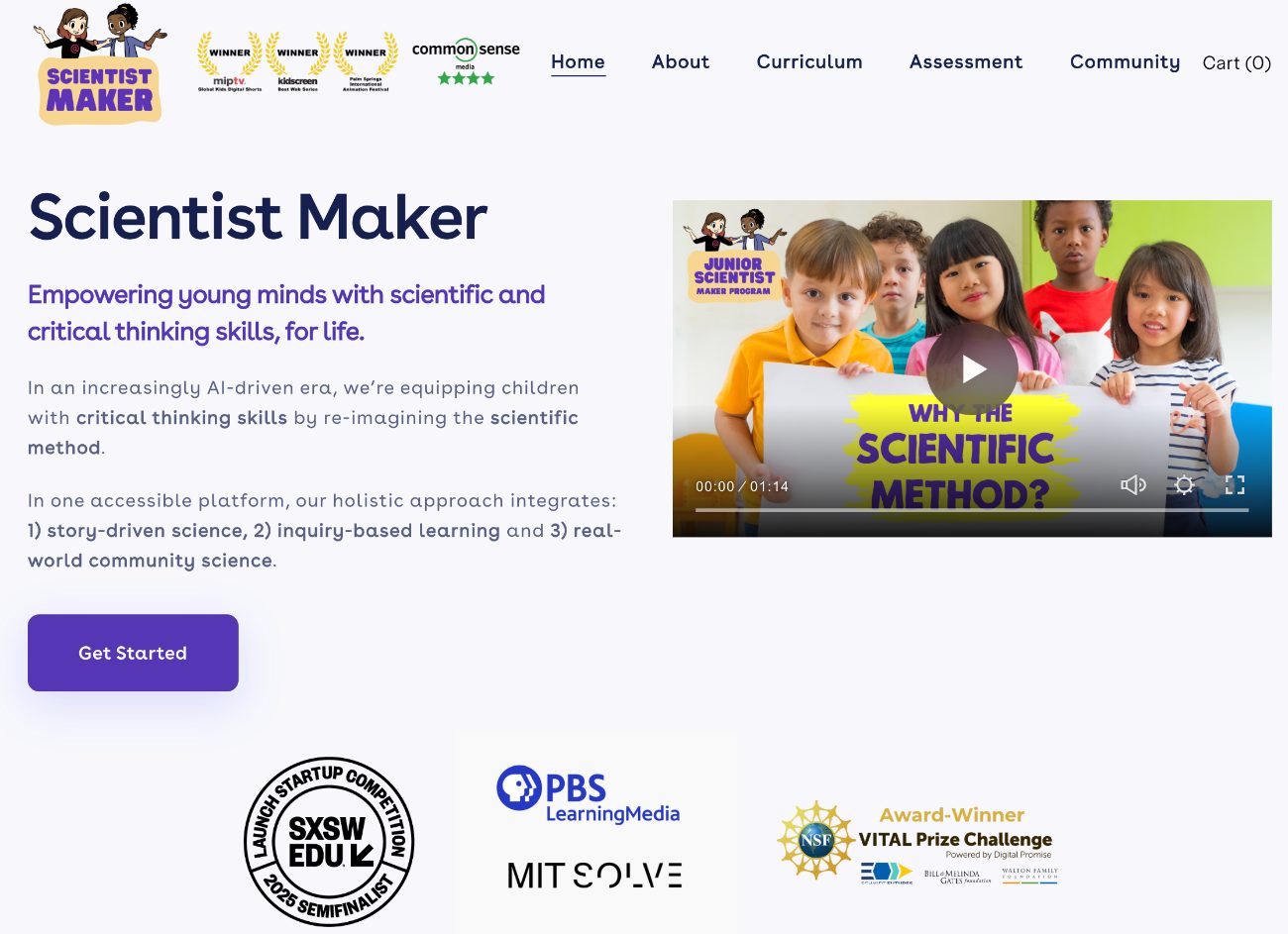
Scientist Maker platform home page
Scientist Maker platform the existing award-winning STEM program the concept was designed to extend. Built by Global Tinker; the newsletter concept was mine.

Outcomes, limitations & next steps

A concept the founders could judge before spending on it.

What I delivered

  • A research-informed newsletter concept
  • A reusable six-section content framework
  • “Science All Around” opening content
  • “Your Commute = A Science Lab” activity
  • A Local Scientist Q&A / interview template
  • The “Create & Explore” section, plus an expanded two-page version
  • Events, resources, community-engagement & call-to-action concepts
  • A two-page layout prototype

How it helped

  • Clarified potential audiences and educational positioning
  • Narrowed scope to what a small team could sustain
  • Gave the founders a tangible artifact to evaluate pre-investment
  • Led to an ongoing intermittent advisory relationship

Not measured

  • The newsletter did not launch
  • No subscriber, open, or click-through data
  • No audience or engagement outcomes
  • No validation with parents, educators, or children

Limitations I'd name to any stakeholder

This concept rests entirely on secondary research and applied judgment. Every claim about what parents want, what children will engage with, and what educators need is inference, not evidence from those people. The competitive analysis tells me what works for other audiences, not for this one. Until the concept is tested with real families, it's a well-grounded hypothesis, and I delivered it as one.

What I'd validate next

  • →

    Concept testing with parents does the 3-part rhythm hold attention, and is the voice right?

  • →

    Activity testing with kids are the activities actually doable and fun, unassisted?

  • →

    A small pilot send before building a production pipeline, with opens, clicks & challenge completions as the baseline.

  • →

    Partnership conversations with schools, nanny agencies, STEM programs & community orgs, the distribution route worth pressure-testing early.

Reflection

Translation is a research skill.

Global Tinker let me do the thing I care about most: take what research says about how children learn and grow, and turn it into something a parent on the subway or a teacher between classes can actually use. A finding buried in a report changes nothing, the same finding, shaped into a warm, well-designed page, can reach the people raising the next generation.

It's also the clearest proof of my throughline: developmental science, in service of the media and tools children grow up with.

Ambiguity is the deliverable.

The founders didn't need more ideas, they needed fewer. The value I added was narrowing an open concept into one audience, one rhythm, and one framework a small team could sustain.

Name the limits of your evidence.

Secondary research was the right tool at this stage, but I delivered the concept with an explicit note on what still needed testing. That honesty is what made it usable rather than speculative.

What I'd change.

I'd push for a handful of informal parent conversations even inside a desk-research budget. A few real voices would have sharpened the voice and format calls that are currently inference.