UX Research · Case Study · 05
The Aisha Project
Helping the creators of an animated history series make a pilot that connects with the kids it's made for, by testing it with real youth.
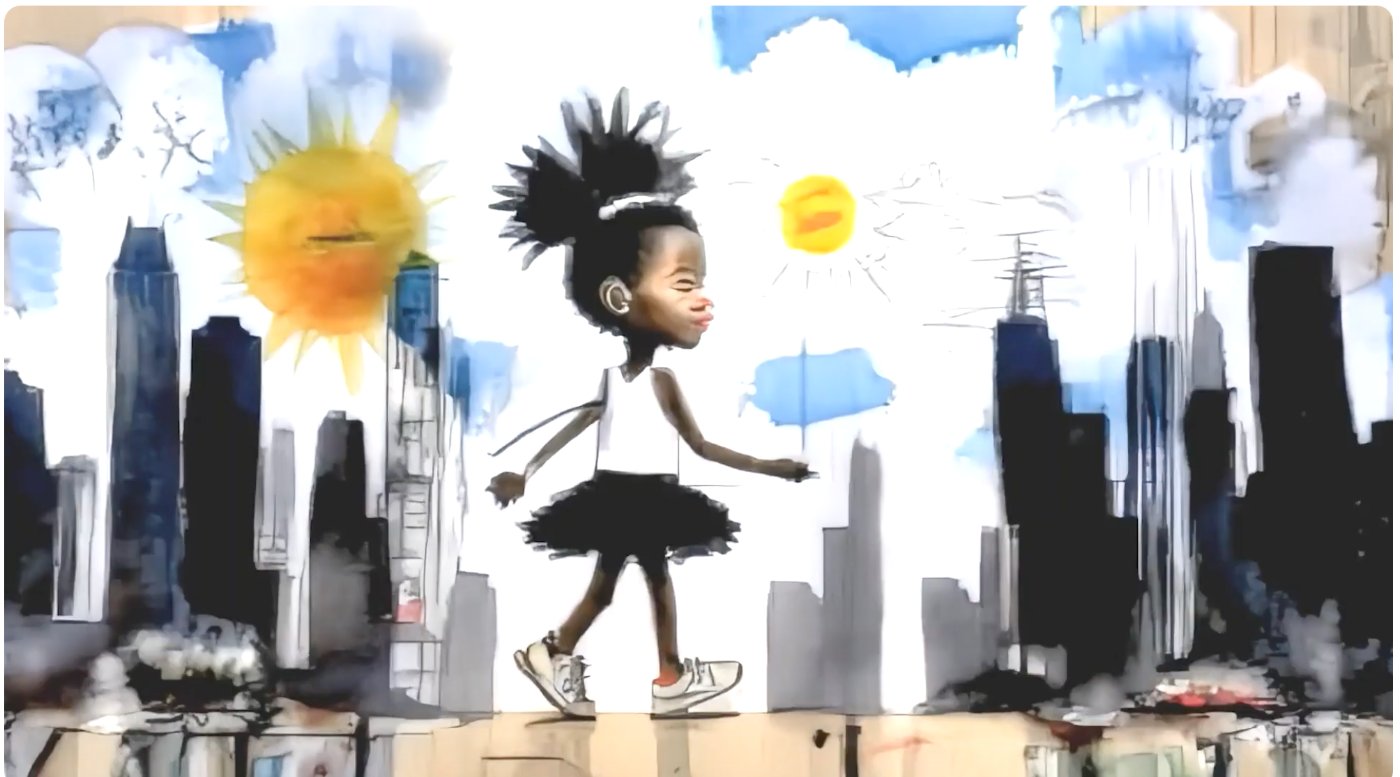
Helping the creators of an animated history series make a pilot that connects with the kids it's made for, by testing it with real youth.
Overview
The Aisha Project is an animated children's series following Aisha, a young girl who goes on adventures to learn about history, culture, and people like her. The pilot episode explores a heavy, important chapter of American history, the Watts Riots.
The creators had a powerful vision but needed to know one thing before investing further: does the pilot actually land with the kids it's for? Do they connect with Aisha, follow the story, and absorb the history, without being overwhelmed?
I was brought on to find out, by putting the episode in front of real young viewers and listening closely.
The Objective
The goal was clear: understand how youth engage with the episode, and what changes could improve clarity, relatability, and narrative engagement.
That meant testing not just whether kids liked it, but whether the story made sense, whether the history came through, and whether the emotional tone fit the intended age group.
My Role
I designed the study, wrote the facilitation script, ran the screenings and discussions with youth, and synthesized everything into clear recommendations for the creators.
Beyond the research itself, I owned the operations: outreach, coordination, scheduling, explaining the study to participants, creating and collecting parental-consent forms, session setup, and refreshments. The creators made the show and connected me to one participating organization; the research was mine end to end.
What I owned
youth participants across two in-person sessions
sessions: one focus group, one larger facilitated discussion
insight themes synthesized from the sessions
prioritized recommendations delivered to the creators
The Method
I ran a pilot screening with a post-viewing discussion. Youth watched the episode, then I facilitated a conversation about what worked, what didn't, and how it made them feel. Screening together let me watch reactions in real time; talking afterward let them explain them in their own words.
Two sessions, deliberately different in size and format:
Focus group, 6 middle-school girls the heart of the target audience. The creators connected me with an organization serving this population; I handled outreach, scheduling, consent, and facilitation.
Facilitated group discussion, 18 students in 10th–11th grade recruited through my after-school program and school network. At this size it was a facilitated classroom-style discussion rather than a focus group, which traded depth per participant for breadth of reaction.
The facilitation script I wrote
Warm welcome & ground rules honest opinions, no right answers, kept private.
Warm-up names, ages, favorite shows, to build comfort.
Screening watch the pilot together.
Open discussion what they learned, what excited them, where they lost interest, and whether they saw themselves in Aisha.
Closeout surprises, the grandmother's lesson on history, and whether they'd recommend it.
Ethics & safeguards
The pilot depicts racial violence, and the participants were children. This was an applied product-research engagement, not an academic study, so the standard I held it to was ethical research practice, developmental appropriateness, and participant agency.
Parental consent before participation. I created and distributed consent forms in both electronic and paper formats, and confirmed permission for every participant.
The study explained to the youth themselves. In age-appropriate language, before anything started, what we were doing and why their opinions mattered.
Youth assent, and voluntary participation reinforced. Participation was theirs to give, and I said so out loud rather than assuming consent covered it.
Freedom to decline, skip, or stop. Any student could opt out, skip a question they didn't want to answer, or leave at any point.
Sensitive content facilitated with attention to comfort. I paced the discussion around how the room was actually responding, not around my question list.
Identities protected everywhere. No names, faces, or identifying details in the research materials or in this case study.
Coordination ran through established school and youth-serving relationships, which is what made consent, scheduling, and a comfortable room possible in the first place.
A core takeaway
Researching children isn't adult research scaled down. Young participants may express reactions through behavior, brief comments, and peer conversation—not only through fully articulated explanations. That changes the whole lens, strategy, and approach.
I supplemented the post-viewing discussion with observation of participants' real-time reactions, moments of confusion, and shifts in attention, alongside group settings that felt social and safe, age-tuned language, and prompts like “do you see yourself in Aisha?” And because this is a show about identity and history, diversity sat at the center of the method who is in the room, whether they feel represented on screen, and whether the story honors their lived experience all shape what you're able to learn. Designing research for children, and for diversity, is a distinct craft.
Synthesis · Findings
The youth were generous and direct. I clustered their reactions into five themes and carried each one through to a recommendation, marking whether the fix came from participants directly or from reading across both sessions.
Limited dialogue and unclear backstory left participants in both sessions asking who she is, what she wants, and why. Her near-silence came up repeatedly.
Interpretation
Without an interior life, Aisha functioned as a device for touring history rather than a character to care about, so the history had nothing to attach to.
Recommendation
Develop her dialogue and inner thoughts, and establish her journey and goals in the first episode.
Confusion clustered around specific plot points: how Aisha got there, what her mission was, and the role of the grandmother and the balloon. Nothing hooked them at the open.
Interpretation
Kids were spending attention on reconstructing what was happening, attention that couldn't go to the history the episode was built to teach.
Recommendation
Open with a moment that grabs attention emotionally or situationally, and clarify the connective tissue between scenes.
Most students were unfamiliar with the Watts Riots and didn't recognize the references, offering only vague guesses. Several described the tone as overwhelming, even scary for younger viewers.
Interpretation
The episode assumed context its audience didn't have. Without scaffolding, heavy imagery reads as frightening rather than educational, exactly the developmental line this show has to walk.
Recommendation
Scaffold the history with age-appropriate storytelling or narration, and reframe visuals and language that read as overly intense.
Students described the visuals as grainy and pixelated, and said they wanted cleaner animation.
Interpretation
This audience is fluent in high-production streaming content. Visual polish isn't vanity here, it's a credibility signal that the story is worth their attention.
Recommendation
Invest in higher-resolution animation or re-editing, and test the aesthetic against youth expectations.
Several students volunteered, unprompted, that the episode would work better later in the season, once viewers know Aisha.
Interpretation
The most structural finding came from the participants themselves. Their instinct matched the evidence: attachment has to precede difficulty.
Recommendation
Position this pilot as a later episode and open the series with character-building and emotional grounding.
Synthesis · Target-audience proto-persona
So the creative team had one concrete kid to write and design for, I built a target-audience proto-persona. She is deliberately younger than the pilot participants: the show's likely core audience sits below the ages I was able to test with, and naming that gap was part of the deliverable.
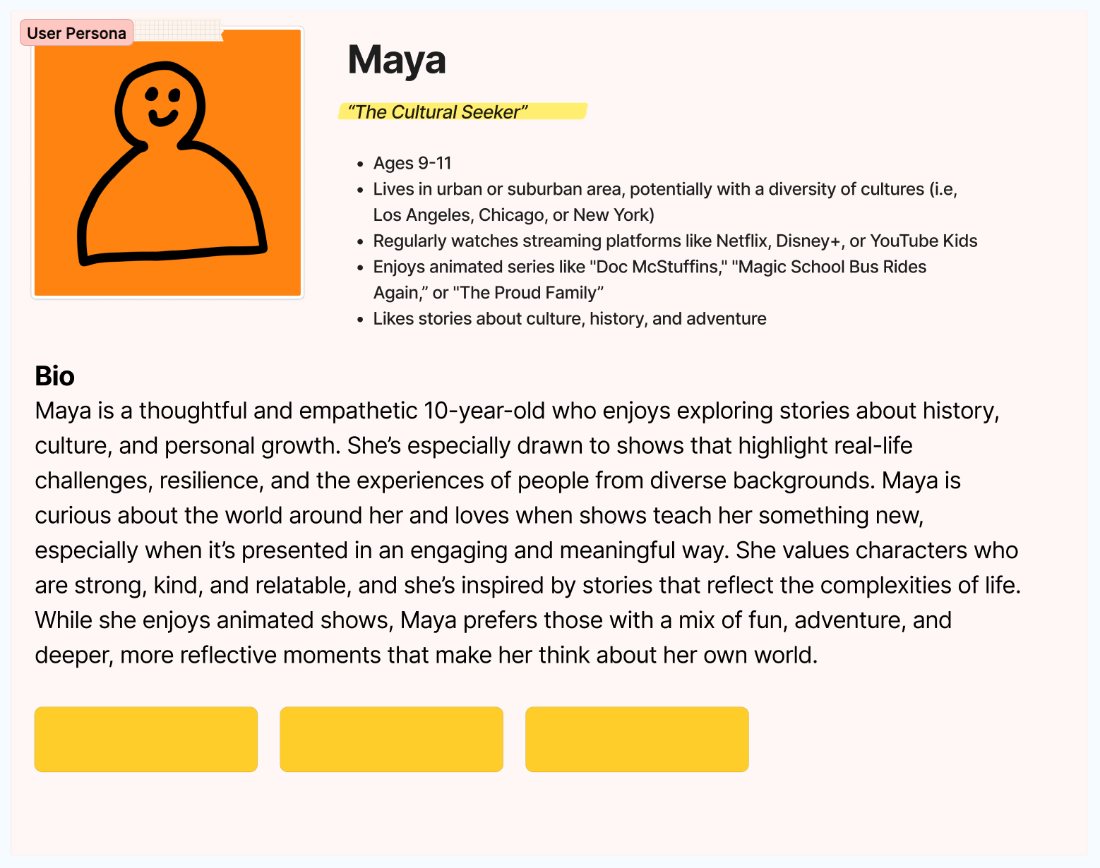
Maya, “The Cultural Seeker” target-audience proto-persona, not a tested participant.
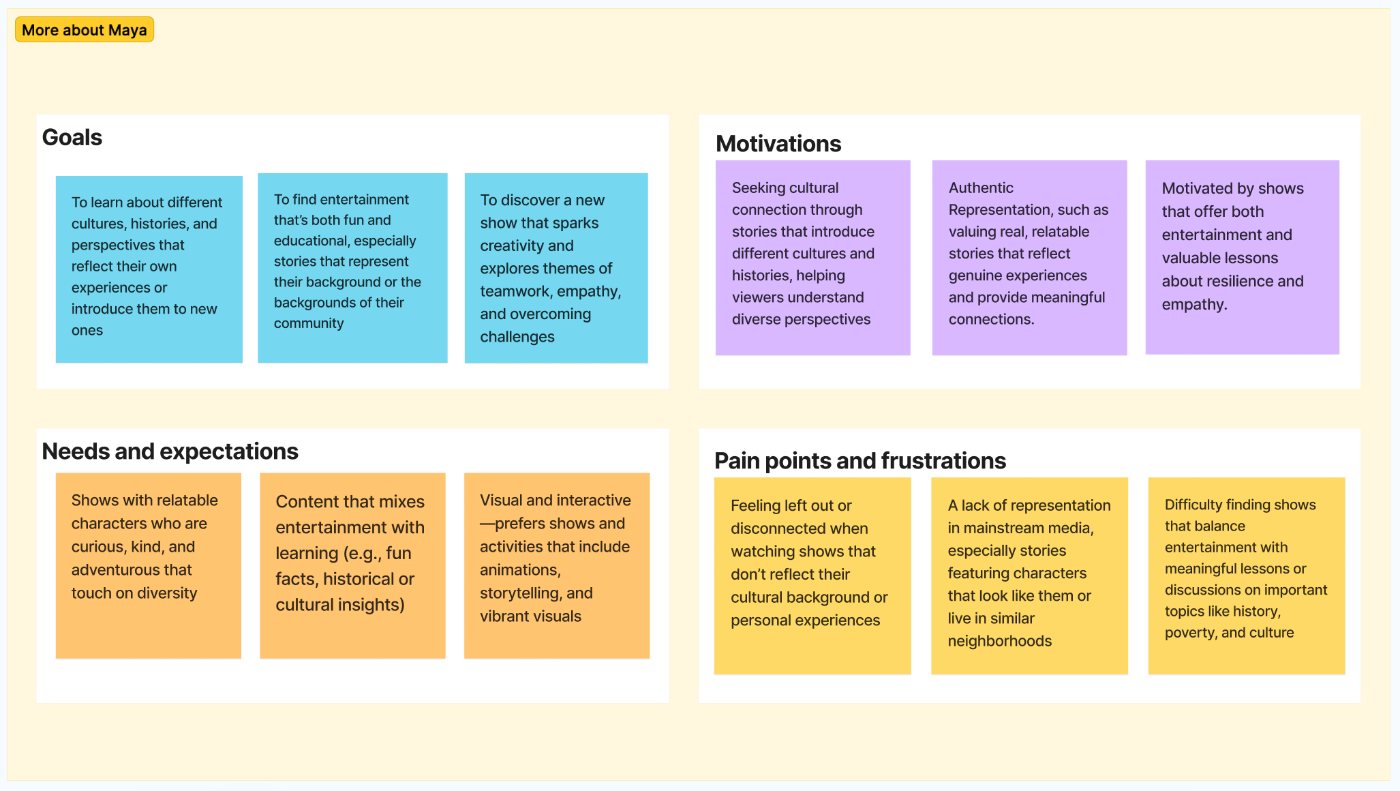
What Maya needs goals, motivations, needs, and pain points.
Recommendations & handoff
I tiered the recommendations so the creators could sequence them: what changes the viewing experience most, what strengthens the craft, and what's a structural call about the series itself.
Highest impact
Center Aisha's story first develop her dialogue and inner thoughts, and establish her journey and goals early.
Create a strong narrative hook open with a moment that grabs attention emotionally or situationally.
Craft & clarity
Clarify historical context age-appropriate storytelling, narration, or layered storytelling for events like the Watts Riots.
Balance tone and emotion reframe visuals and language that feel overly intense.
Improve visual quality higher-resolution animation or re-editing, tested against youth expectations.
Structural
Sequence the series thoughtfully position this pilot as a later episode and open with character-building and emotional grounding for Aisha.
Outcomes, limitations & next steps
Research output
Research influence
Not measured
The 18-person session was large enough that quieter students likely didn't speak, so its reactions skew toward the more vocal participants, and I can't treat those two sessions as equivalent evidence. Both groups were also older than the show's likely core audience, which is precisely why the tone finding needs retesting rather than acting as settled. Participants were reached through organizations and networks I already had access to, not independently recruited.
Testing with ages 10–12 to see how tone and educational content land with the actual target audience.
Parent feedback sessions to understand family fit and comfort with the content.
Research comparables Little Bill, Gullah Gullah Island, The Proud Family, and Ada Twist, Scientist.
Script & storyboard revisions that scaffold the history to Aisha's personal journey.
Smaller groups next round so every participant has room to speak.
Reflection
This project is the clearest expression of where I'm headed: using research to shape the media children grow up on. It pulled together everything, my developmental-science training, my UX research practice, and a real love for getting kids' perspectives right.
It also showed how much developmental nuance matters: content that feels manageable to an older teenager may affect a younger viewer differently, which is why the pilot still needs direct testing with children ages 10–12.
Screening together and talking afterward surfaced reactions, confusion, fear, and delight that a survey alone would likely have missed.
“Do you see yourself in Aisha?” was central. Whether kids connect with a character is testable, and essential for a show built on identity and history.
Eighteen students gave me breadth fast, but I'd trade it for smaller rooms next time. The six-person session produced more usable evidence per participant, and that's worth naming rather than smoothing over.
The kindest thing I could do for the creators was tell them the truth, clearly, warmly, and with a path forward, and they took it and started iterating.