Lead UX Research · Case Study · 01
FeelWell
A product by Psyflo
Building the research foundation for an AI mental-health platform supporting students, and the counselors stretched too thin to reach them.
A product by Psyflo
Building the research foundation for an AI mental-health platform supporting students, and the counselors stretched too thin to reach them.
Overview
Schools across the U.S. face a growing youth mental-health crisis. Students experiencing anxiety, depression, trauma, and instability often go unidentified, counselors frequently manage hundreds of students, making proactive support nearly impossible.
Psyflo set out to answer one question: how might we use AI to provide scalable emotional support for students, while helping schools identify youth who need additional intervention?
The result was FeelWell a student-centered platform combining emotional check-ins, mental-health education, wellness tools, reflection activities, AI-powered support conversations, and planned pathways to counselor or adult support.
My role & the team
I joined during the early MVP stage and became responsible for creating FeelWell's research strategy and infrastructure from scratch the roadmap, the questions, the success metrics, the testing plans, the materials, and the systems for bringing student and educator voice into the product.
This was a sustained, embedded engagement rather than a one-off study, and it ran across four phases: discovery, research strategy, student testing, and a standing Youth Advisory Board I built and recruited.
The founder set product vision and led the business and school-partner relationships; design and engineering built and shipped the platform. I was the research function, and they were my partners and the recipients of every plan, script, synthesis, and recommendation described here. I did not design, engineer, launch, or clinically validate the product.
What I created & owned
students I tested with, across two group sessions
students per session, moderated as group testing
Youth Advisory Board members, students ages 15–17, I recruited & facilitated
research phases, discovery through pilot framework
The approach
Each phase answered a different kind of question, so the method had to change with it: generative work to understand a system nobody had mapped for us, evaluative work to see the product through students' eyes, and participatory work to keep young people in the room after the sessions ended.
Mapped the school mental-health ecosystem, clinics, community health orgs, providers, and existing implementation models, plus competitor products, service models, stakeholder needs, funding, and adoption barriers. Exploratory first, because a usability finding means little if the delivery model can't reach a school.
Built the research framework for the planned pilot: objectives, core questions, success metrics, and the evaluation plan for students and educators, so every question mapped to a method and to a decision it would inform.
Wrote the scripts and moderated two group sessions with five students each across the homepage, mood check-in, wellness checks, the AI chatbot, and future concepts. Group format traded some individual task depth for candor, students built on each other's reactions to talking with an AI about their feelings.
Established an active board of six students ages 15–17 so young people became collaborators rather than one-time participants, its research structure, recruitment, application, guides, and recurring co-creation sessions.
Phase 1 · Discovery
Before testing anything, I ran exploratory research to understand the world FeelWell would have to live in, how school mental health actually gets delivered, and what would make or break adoption.
This shaped both the product direction and the implementation strategy the team built around, and it's what later told us that school access, not student interest, would be the real constraint.
Clinics, community health organizations, family-medicine providers, community health workers, and existing implementation models.
Competitor products, service-delivery models, and where FeelWell could meaningfully differentiate.
Stakeholder needs, funding opportunities, and the barriers that determine whether schools actually implement.
Phase 2 · MVP research strategy
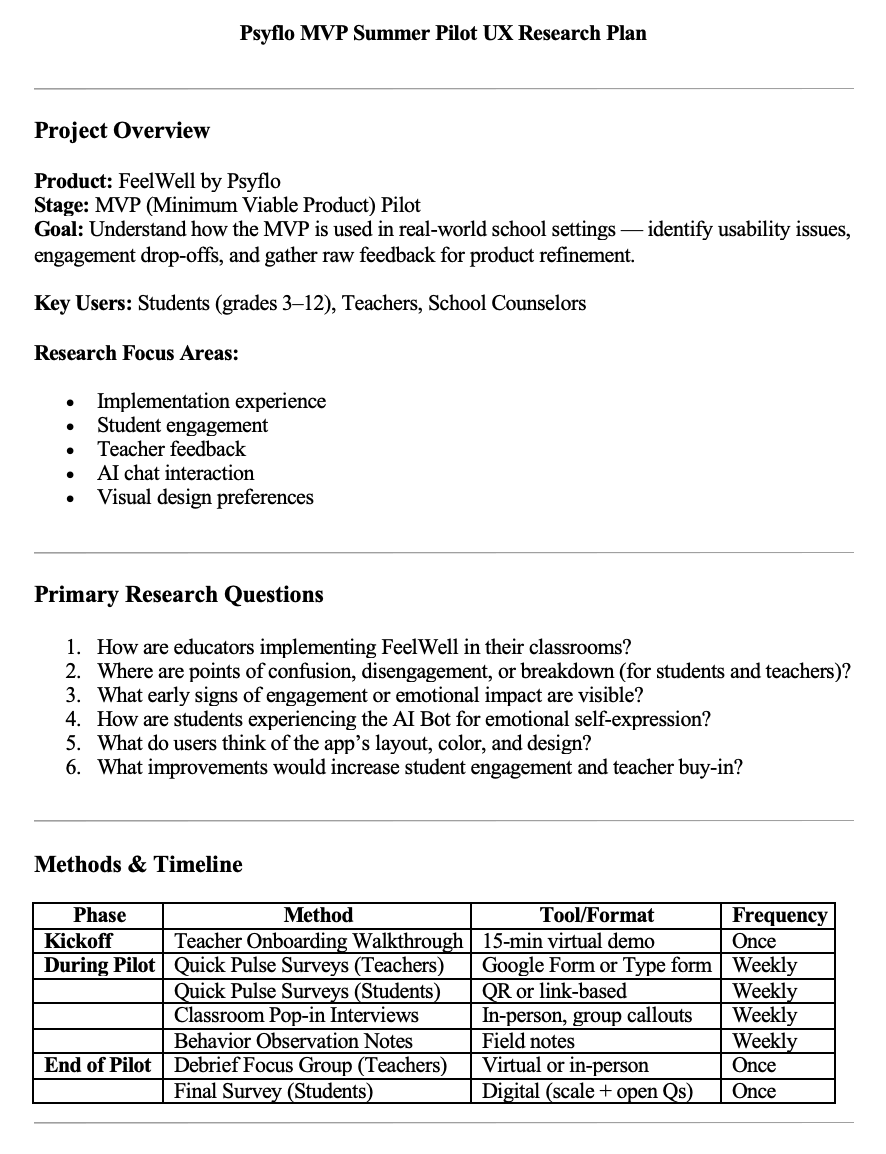
I defined the research framework for the planned pilot, turning a broad ambition into specific, answerable questions the whole team could rally around, then paired each one with a method, a success metric, and the decision it would inform.
This framework is also what let us separate what we could learn immediately from what depended on school access.
How are educators implementing FeelWell?
Where are students becoming confused or disengaged?
How are students experiencing the AI chatbot?
What impact does the platform have on emotional reflection?
Which design elements drive engagement?
What improvements would increase adoption?
Phase 3 · Student group testing
I wrote the scripts and moderated two group testing sessions with five students each, ten students in total, walking through the homepage, mood check-in, wellness checks, the AI chatbot, and the concepts that might come next. Group sessions, not individual usability tests: the format gave up some task-level precision and gained honest, peer-to-peer talk about what it feels like to tell an app you're not okay. These sessions were distinct from the recurring Youth Advisory Board meetings described further down.
What we tested
We started on the homepage, exploring navigation expectations, visual hierarchy, and first impressions. Students talked through what stood out, what was confusing, and how they expected to move between the main features.
This was the starting point for every session, and it set the frame: if the daily journey didn't read clearly in ten seconds, nothing downstream would.
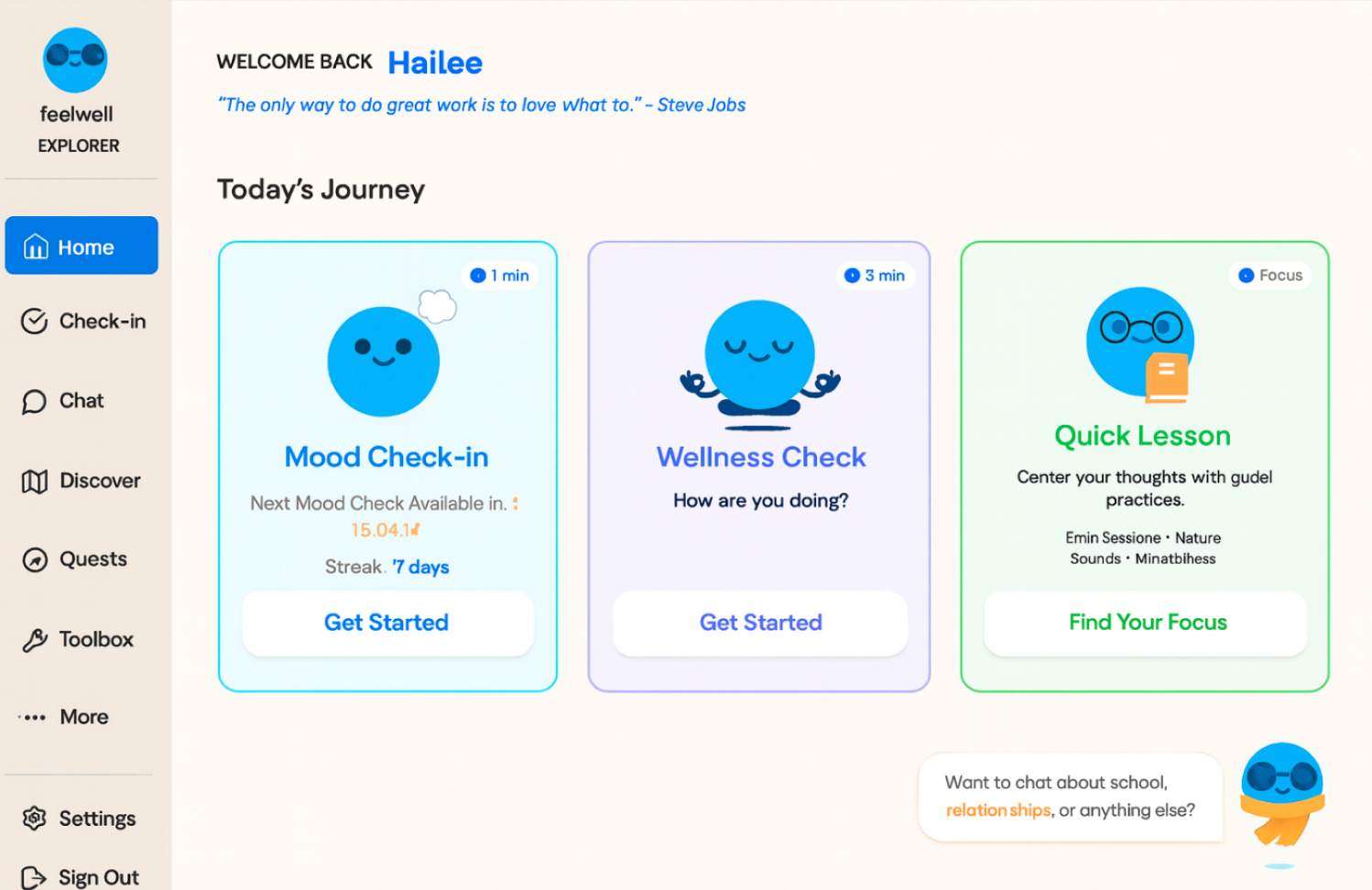
FeelWell dashboard the starting point for most students in our sessions. Built by Psyflo's design and engineering team; I wrote the scripts and moderated.
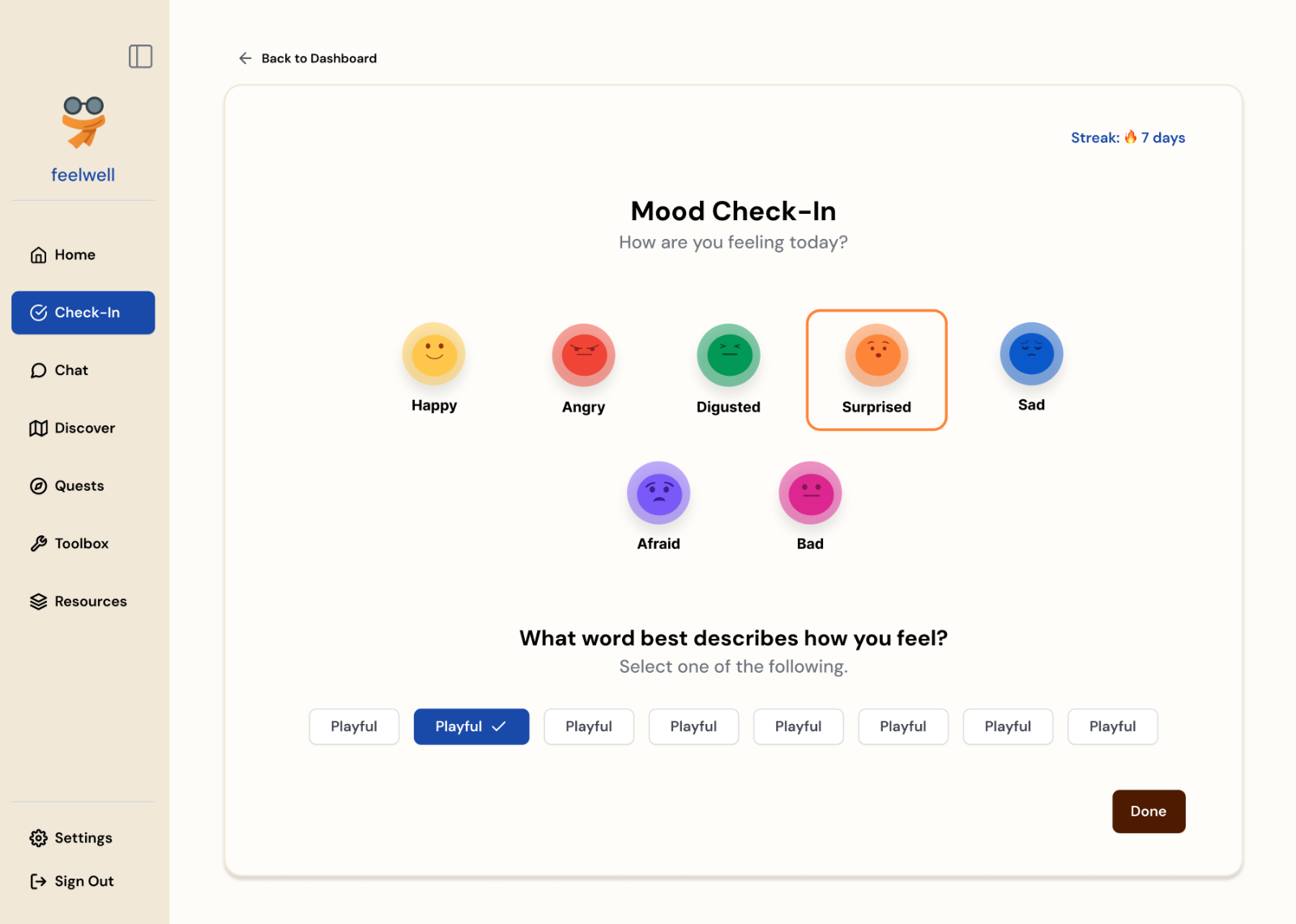
Mood check-in exploring emotional language and comprehension.
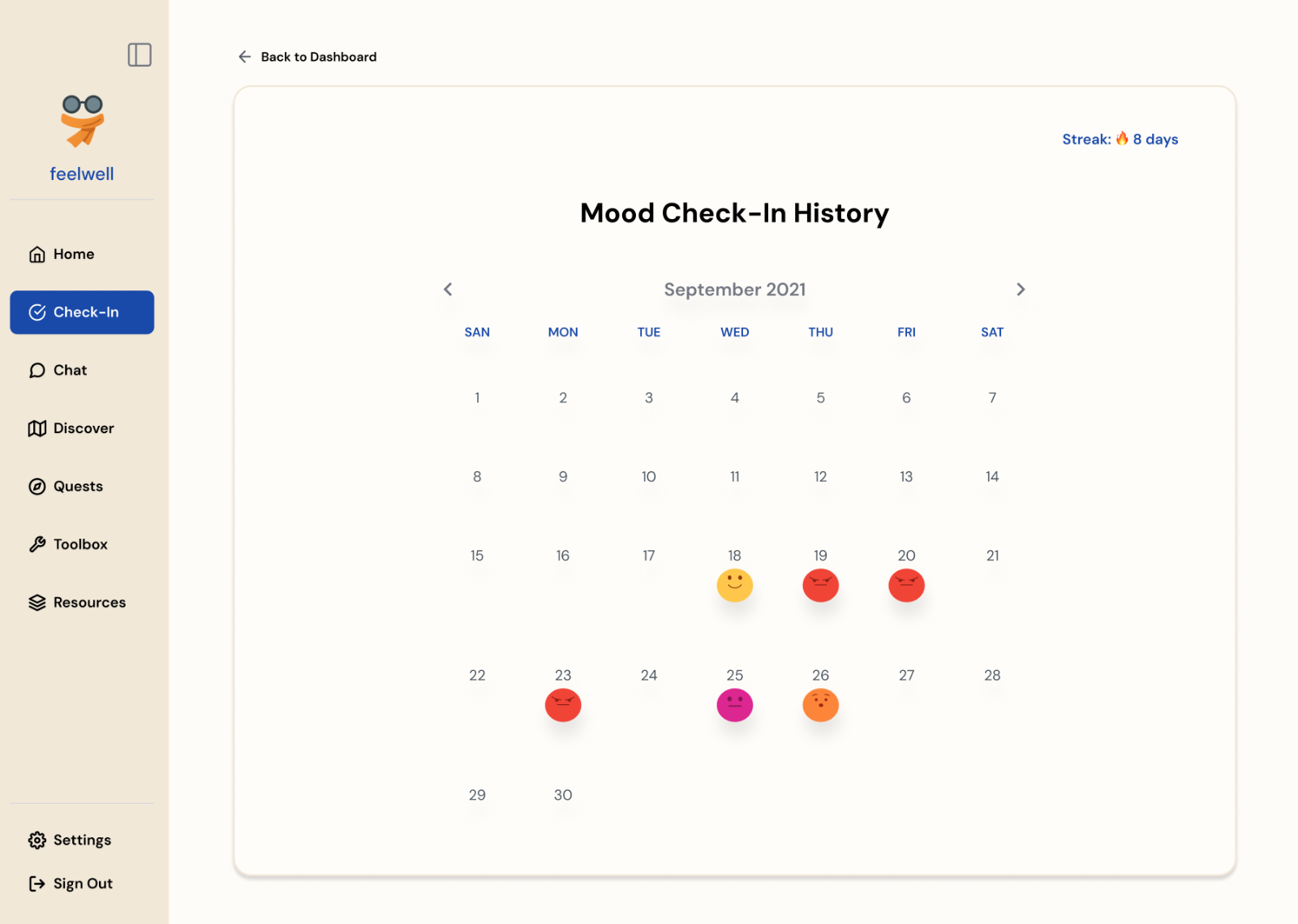
Mood history how students wanted past check-ins displayed over time.
Mood check-in
Students explored the check-in flow and gave feedback on the emotional language, the icons, and how easily they could find a word that felt right. Several wanted to select more than one emotion at a time, because how they actually felt rarely fit a single label.
Mood history was among the most positively received concepts: they didn't just want to log a bad day, they wanted evidence they were changing.
“It feels simple, not overwhelming.”
Student participant
Trust and safety
We tested the AI chat to understand how students perceived its usefulness, what would make it feel trustworthy, and what worried them. Most had already used AI tools and were willing to discuss emotional challenges with one, on conditions.
The clearest trust-builder they named was the platform stating plainly what stays private, what gets reported, and why, in language a 13-year-old can read. Every condition became a design requirement, not a preference.
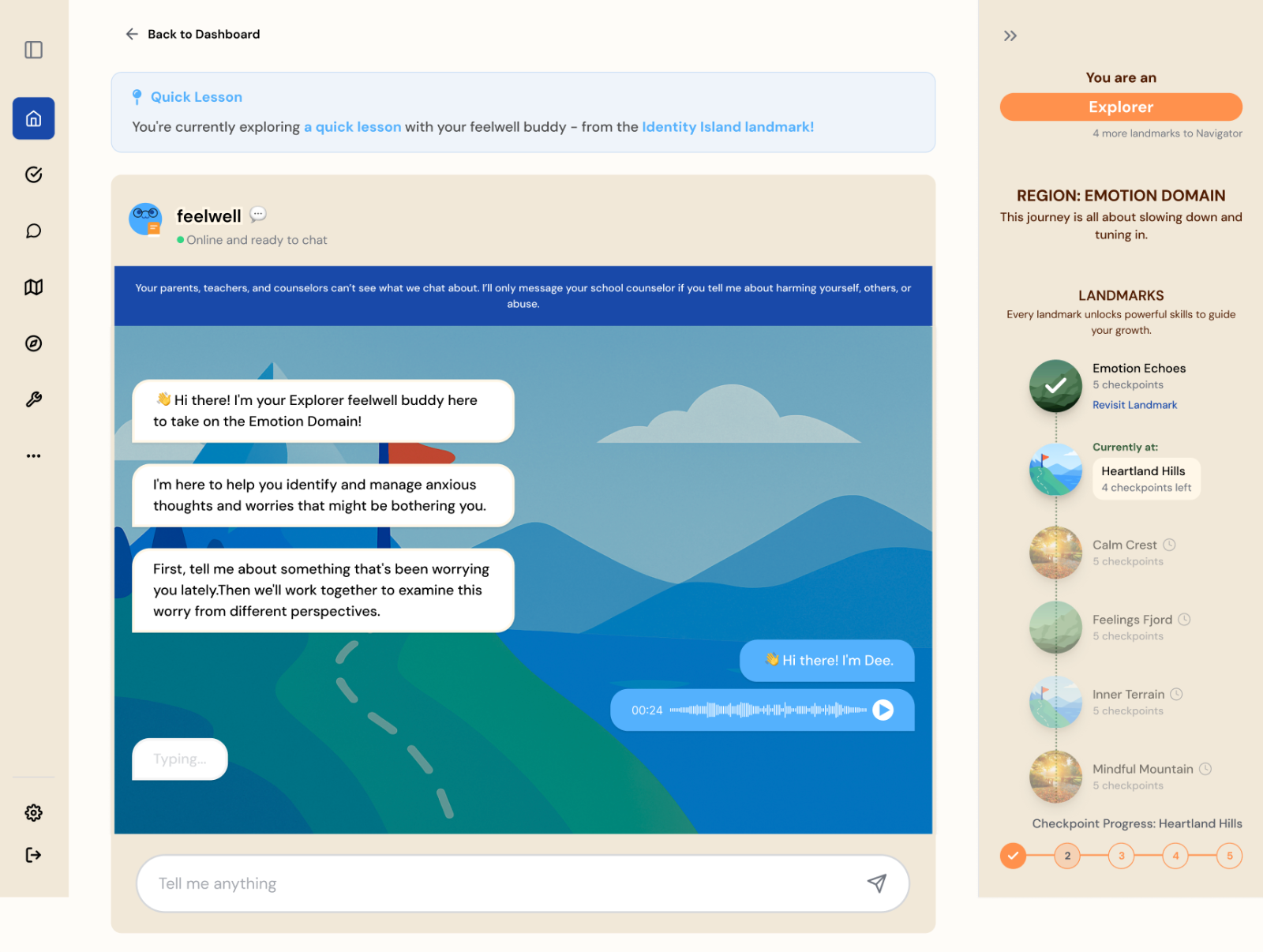
FeelWell chatbot testing trust, usefulness, and safety considerations.
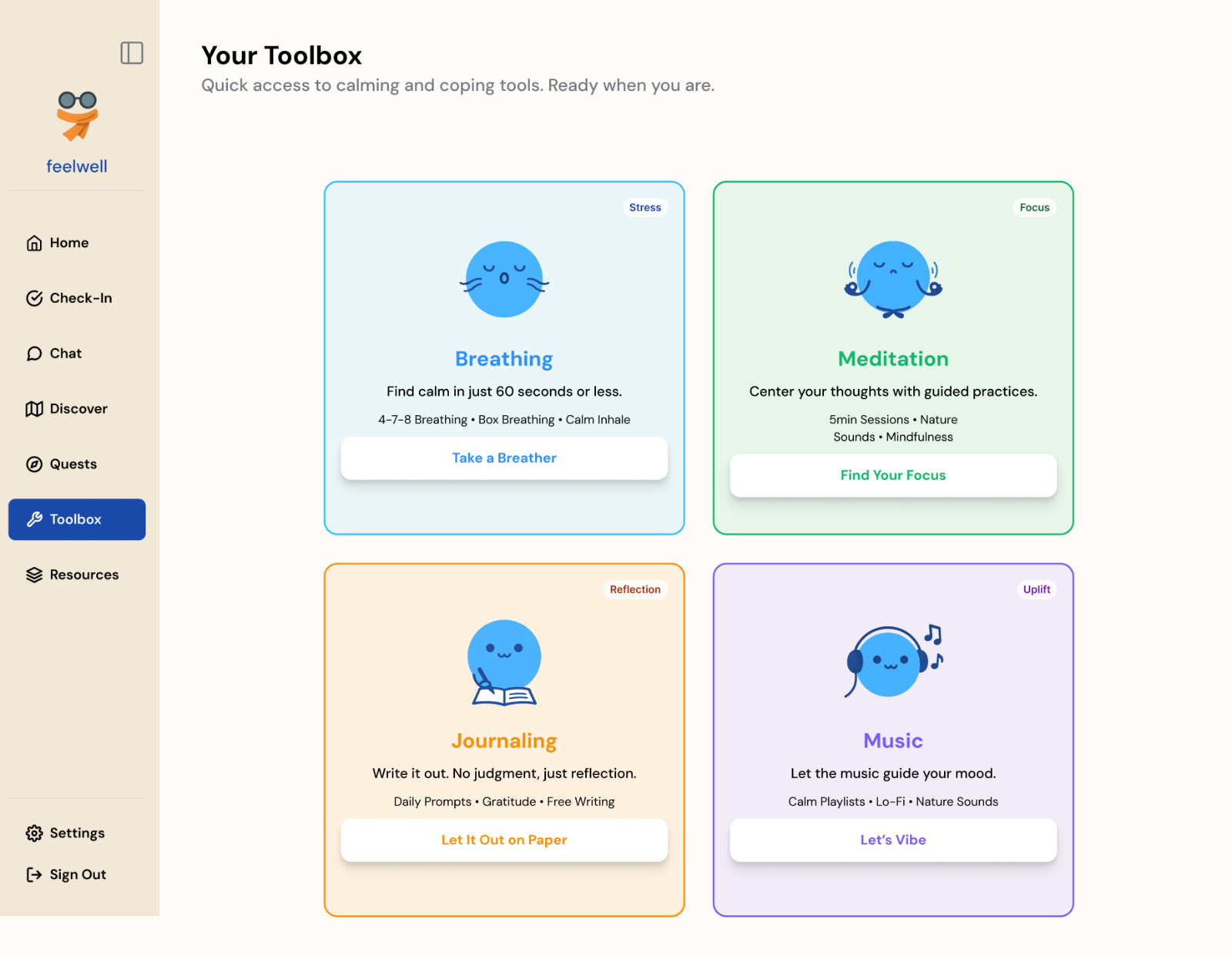
Coping toolbox varied preferences for how to calm down or reset.
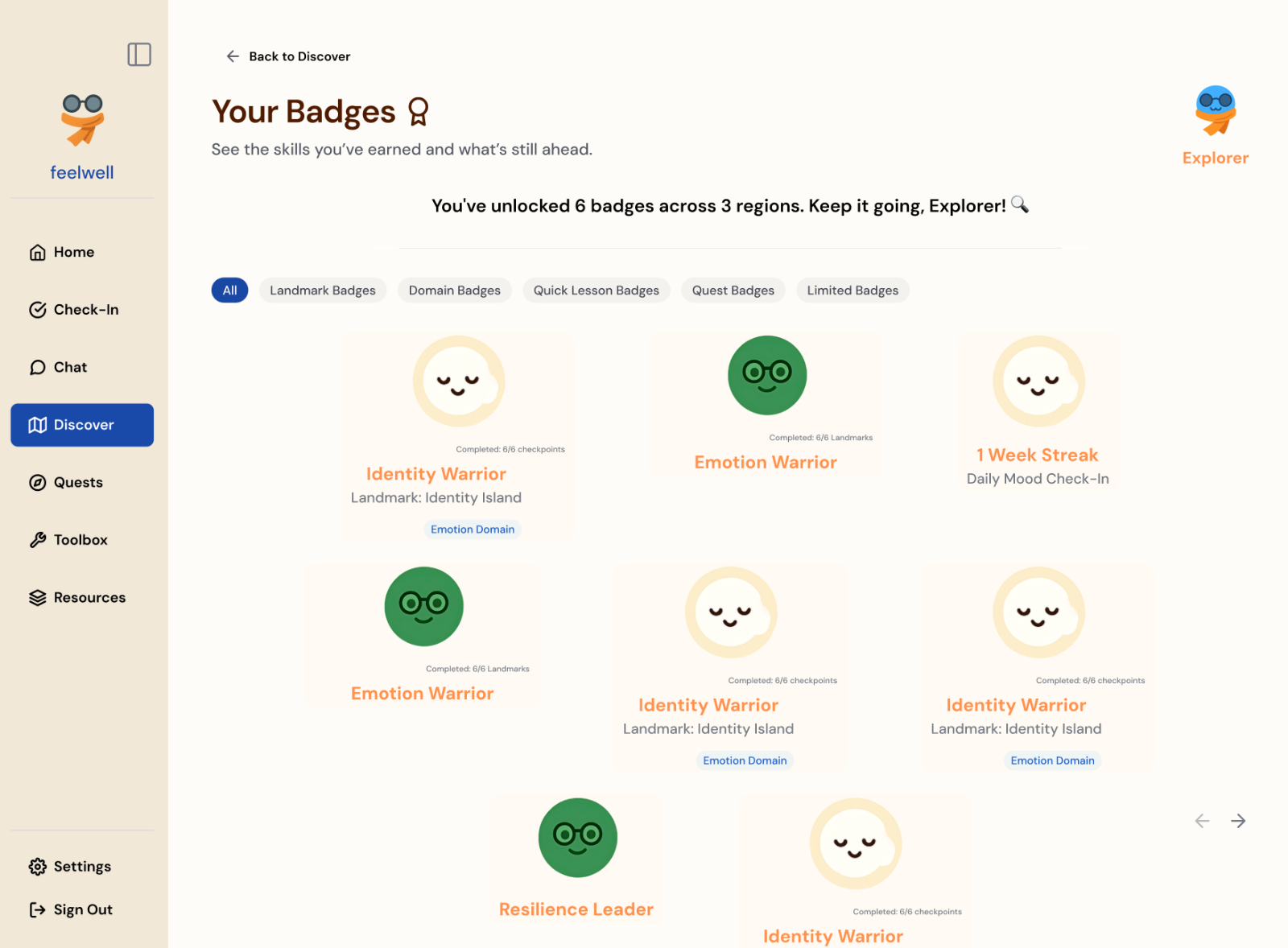
Achievements streaks and badges, motivating but easy to get wrong.
What changed
Students wanted ownership of the space: custom themes, a personalized toolbox, more than one way to calm down. That ownership was what made emotional disclosure feel safer, a small feature carrying real weight.
Gamification drew strong positive responses, but I flagged the risk alongside it: reward systems must not make a missed day feel like failure. Their input shaped everything from copy changes to the mood calendar, badges, and personalization now on the roadmap.
“Their feedback gave the product a more human, grounded feel.”
Research & design considerations
This work sat at the intersection of three sensitive areas at once, so a set of considerations ran through every session and every recommendation I made. These were research and design judgments, not a formal clinical or compliance protocol.
What stays private and what a school can see had to be legible to a 13-year-old, not buried in policy language.
Emotion words, wellness questions, and AI replies tested for comprehension, not just tone.
Whether replies felt useful and fair, and where a generic answer could read as dismissive to a student in distress.
Students needed to see that adult and school support existed alongside the AI, never replaced by it.
Sessions were run so students could speak generally about feelings without being pushed to disclose personal crises.
Students wanted ownership of the experience; the question was how far customization should go in a mental-health context.
The turning point
The pilot was planned and then delayed. Schools had competing calendars, internal approval processes, limited staff availability, and scheduling constraints that pushed pilot timing and limited participant access.
The lesson I took from it: research with minors in school environments depends on far more than a strong plan. It needs trusted school relationships, administrative coordination, flexible scheduling, participation requirements everyone understands, careful communication with educators and families, and a plan that can bend to the academic calendar.
Rather than wait, I used existing school relationships and professional connections to recruit the Youth Advisory Board and keep student voice flowing into the product while the broader pilot was still being coordinated. The board became the mechanism that kept research moving.
Phase 4 · Youth Advisory Board
One of my most consequential contributions: rather than treating students only as test participants, I established an active Youth Advisory Board, its research structure, its application and session materials, and the framework for ongoing youth participation, so young people became continuing collaborators on a product built for them.
I recruited, onboarded, and facilitated six members, students ages 15–17, through school and community referrals, drawing on existing relationships with educators and school partners. Members were compensated with Uber Eats gift cards for their time, participation is work, and paying for it is part of doing this ethically.
Across multiple meetings, members gave ongoing feedback on trust, privacy, language, feature priorities, and how FeelWell should support, not replace, human relationships. These recurring advisory meetings were separate from the two moderated testing sessions.
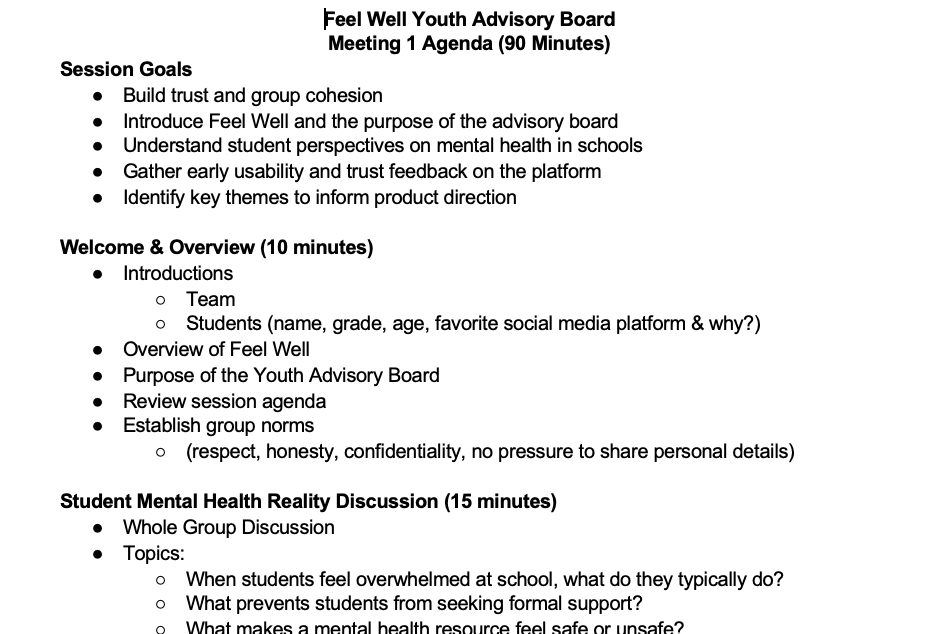
Youth Advisory Board facilitation agenda a 90-minute session I designed and facilitated. Click to expand.
What I built, and what it surfaced
I built the board's research structure and participation framework, its application and recruitment process, the discussion guides and session agendas, the feedback frameworks for recurring sessions, and the co-creation exercises and design critiques we ran inside them.
Across those meetings the board surfaced what a one-off study can't: student mental-health realities and support-seeking behavior, how young people actually perceive and distrust AI, product opportunities and design preferences, and which features mattered enough to build first.
Six high-school students named trust barriers, must-have features, deal-breakers, and specific opportunities to improve privacy, tone, and access.
Synthesis · Key findings
I centralized observations from the group sessions and board conversations, clustered them into themes, then carried each one through to a recommendation. Where a fix came straight from students, it's marked as theirs.
Counselors were described as unavailable or overextended.
Interpretation
FeelWell's value wasn't novelty, it was availability when no adult was free. Framing had to speak to that gap, not to "wellness."
Recommendation
Position the product around access and immediacy, and keep human support visible alongside it.
Most students had already used AI tools and were willing to discuss emotional challenges with one, if replies were helpful, privacy was clear, and human support remained available.
Interpretation
Openness was real but conditional. Every condition was a design requirement, not a preference.
Recommendation
Improve chatbot onboarding and add conversation starters so the first exchange proves usefulness quickly.
The clearest trust-builder students named was explicitly explaining what stays private, what gets reported, and why escalation happens.
Interpretation
Trust wasn't a tone problem, it was an information-design problem, and silence read as risk.
Recommendation
State privacy and escalation in plain, age-appropriate language at the point of disclosure.
Mood-history concepts were among the most positively received, students wanted to see emotional trends and growth over time.
Interpretation
Students weren't only managing a bad day, they wanted evidence they were changing.
Recommendation
Add a mood-history calendar and journaling integration in the medium term.
Streaks, progress indicators, unlockable content, and achievements all drew positive responses.
Interpretation
Return visits needed a reason that wasn't distress, but rewards had to avoid making a missed day feel like failure.
Recommendation
Build engagement systems as a longer-term investment, tested against that risk.
Custom themes, backgrounds, and greater ownership over the experience came up repeatedly.
Interpretation
Ownership of the space made emotional disclosure feel safer, a small feature carrying real weight.
Recommendation
Add personalization and expand emotional-vocabulary options, including multiple emotion selections.
Recommendations & handoff
I translated the research into tiered, prioritized recommendations the founder, design, and engineering partners could sequence against the MVP and beyond, and delivered them alongside the pilot framework so the next phase had a plan and a baseline.
Immediate
Allow multiple emotion selections
Improve chatbot onboarding
Add conversation starters
Improve mobile responsiveness
Clarify navigation labels
Medium-term
Add a mood-history calendar
Add journaling integration
Add personalization features
Expand emotional-vocabulary options
Long-term
Build engagement systems
Create counselor dashboards
Develop risk-escalation workflows
Expand educational content
Outcomes, limitations & next steps
Completed research
Planned or delayed
Not measured
Ten students across two group sessions is a small, non-representative sample, and the group format means I can't report individual task success. The advisory board added depth over time but stayed small, six students ages 15–17, so younger students' perspectives are underrepresented. Educator implementation, the first research question, remains largely unanswered because it depended on the delayed pilot.
Run the pilot on the existing framework once school access is secured, then measure the questions it was built for: educator implementation, engagement patterns, and how students experience the chatbot over weeks rather than one sitting. Add individual sessions alongside group ones to get task-level evidence, and test the transparency language directly, since trust rested on it.
Reflection
FeelWell is the project where I most clearly built a research function rather than executed a study. Walking into an early MVP and standing up the roadmap, the materials, the testing plans, and a living Youth Advisory Board showed me what research leadership actually looks like.
It also sits at the heart of where I'm headed: youth mental health, trust and safety in AI, and designing technology with young people instead of just for them.
“Will students trust an AI with their feelings?” became concrete UI: transparent privacy, clear escalation language, and visible human backup. Emotional safety has to be designed.
The strongest plan I wrote couldn't outpace school calendars. Building relationships, and having a second path to student voice ready, mattered as much as method design.
I'd secure school scheduling commitments before sequencing the study, and pair group sessions with a few individual ones from the start so I had both candor and task-level evidence.
Adolescent development, mental health, and equitable access, researched with care and rigor, is exactly the work I want to keep doing.